Primate Ecology and Behavior


Project Desciption and Aims
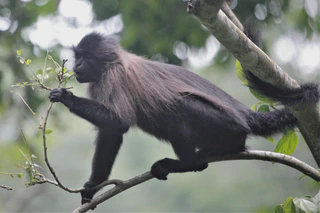
Nonhuman primates’ social and dietary diversity make them ideal for testing socioecological hypotheses. Kibale National Park is exceptional in this regard, with 13 primate species spanning diverse diets, group sizes and dynamics, social structures, mating systems, movement patterns, and other behavioral dimensions. Within this context, we investigate the causes and consequences of behavioral variation, with an emphasis on the folivorous Ugandan red colobus (Piliocolobus tephrosceles).
Current projects, drawing on more than a decade of data, examine context-dependent dietary preferences (using tree phenology and distribution), social relationships, and ranging. Ongoing work integrates high-resolution food-resource maps with behavioral observations and GPS-collar data to link food distribution to social dynamics, activity budgets, and movement.
Contact Information
Urs Kalbitzer, Colin Chapman, Martin Golooba

